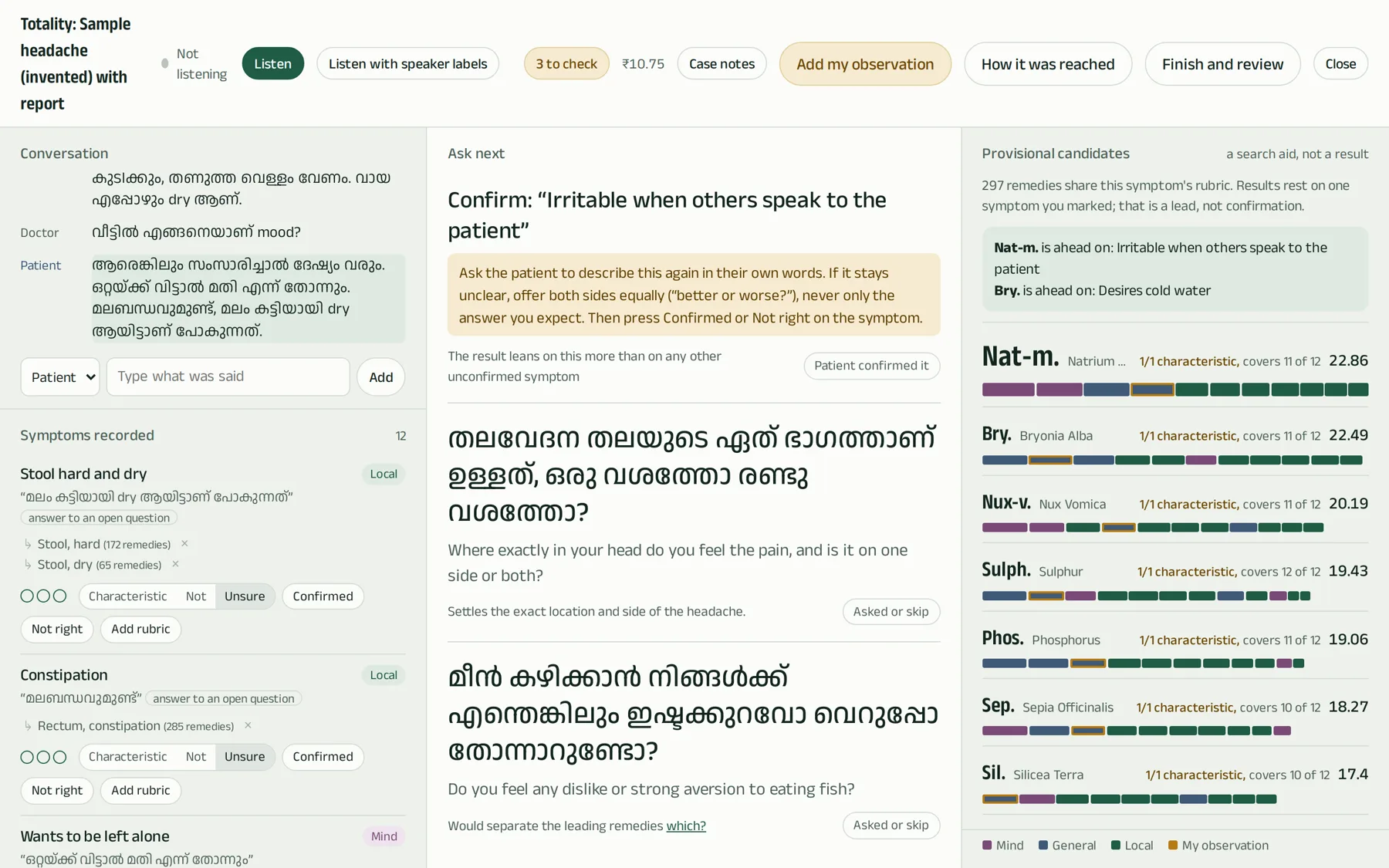
From the patient's words to a repertory sheet, with nothing hidden.
Totality does the writing and the looking-up. The judgements that make a prescription stay with the doctor.
- 1
It listens
The consultation is written down as it happens, in Malayalam, English or both, with doctor and patient told apart.
- 2
It records the case
Each symptom is kept with the patient's own words and how it came up: said unasked, in answer to an open question, or only a yes to a suggestive one.
- 3
It finds the rubrics
Rubrics are chosen only from a real repertory, each with the reason it was chosen and what else was considered.
- 4
You judge and decide
You mark what is characteristic. Only then do candidates appear, as a repertory chart you can check by hand.
The next question, in the language of the room.
Totality suggests what would make the record sounder: the most individual symptom still vague, a part of the case not yet explored. Questions are open, never leading, and shown in Malayalam and English.
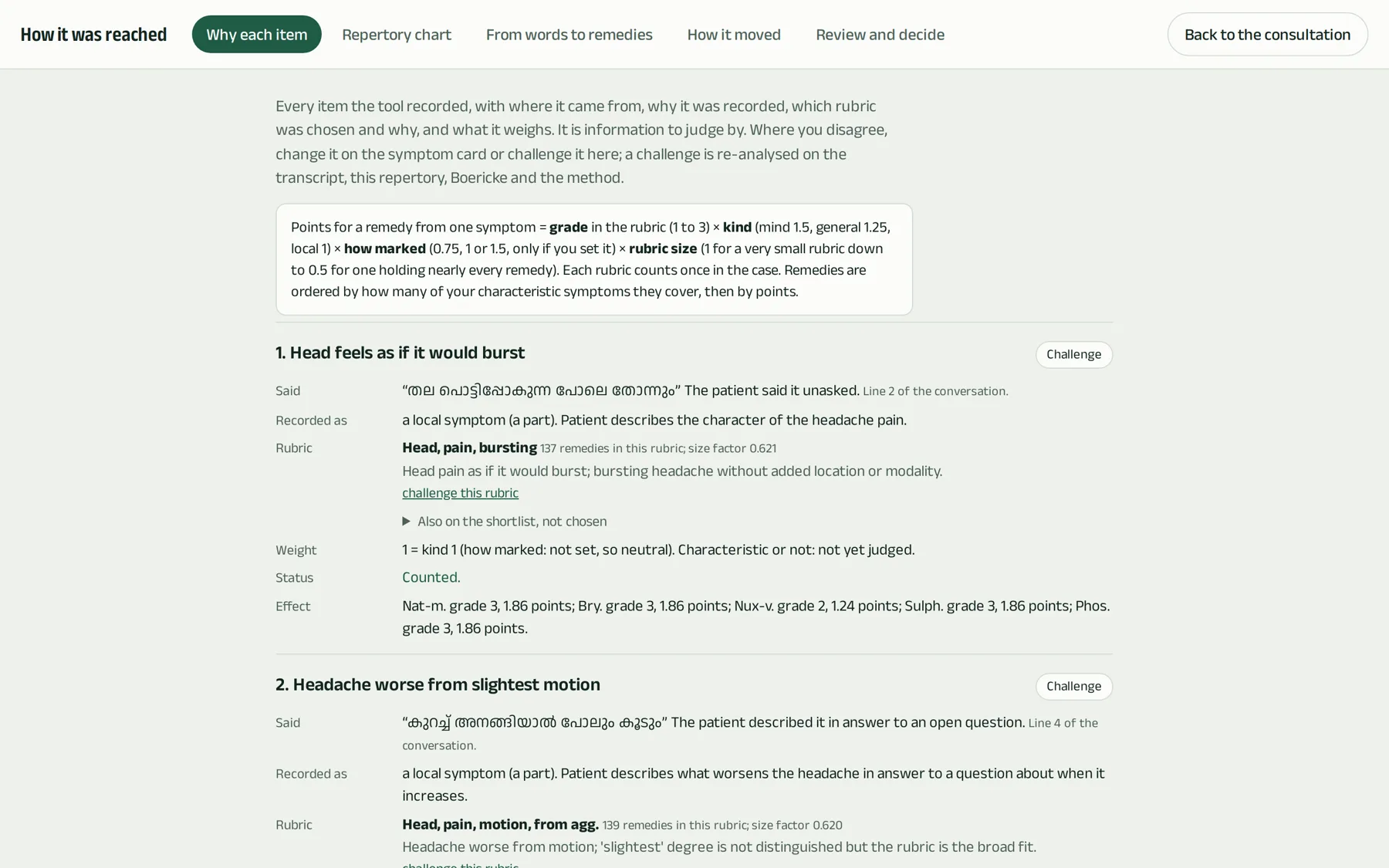
A repertory chart you already know how to read.
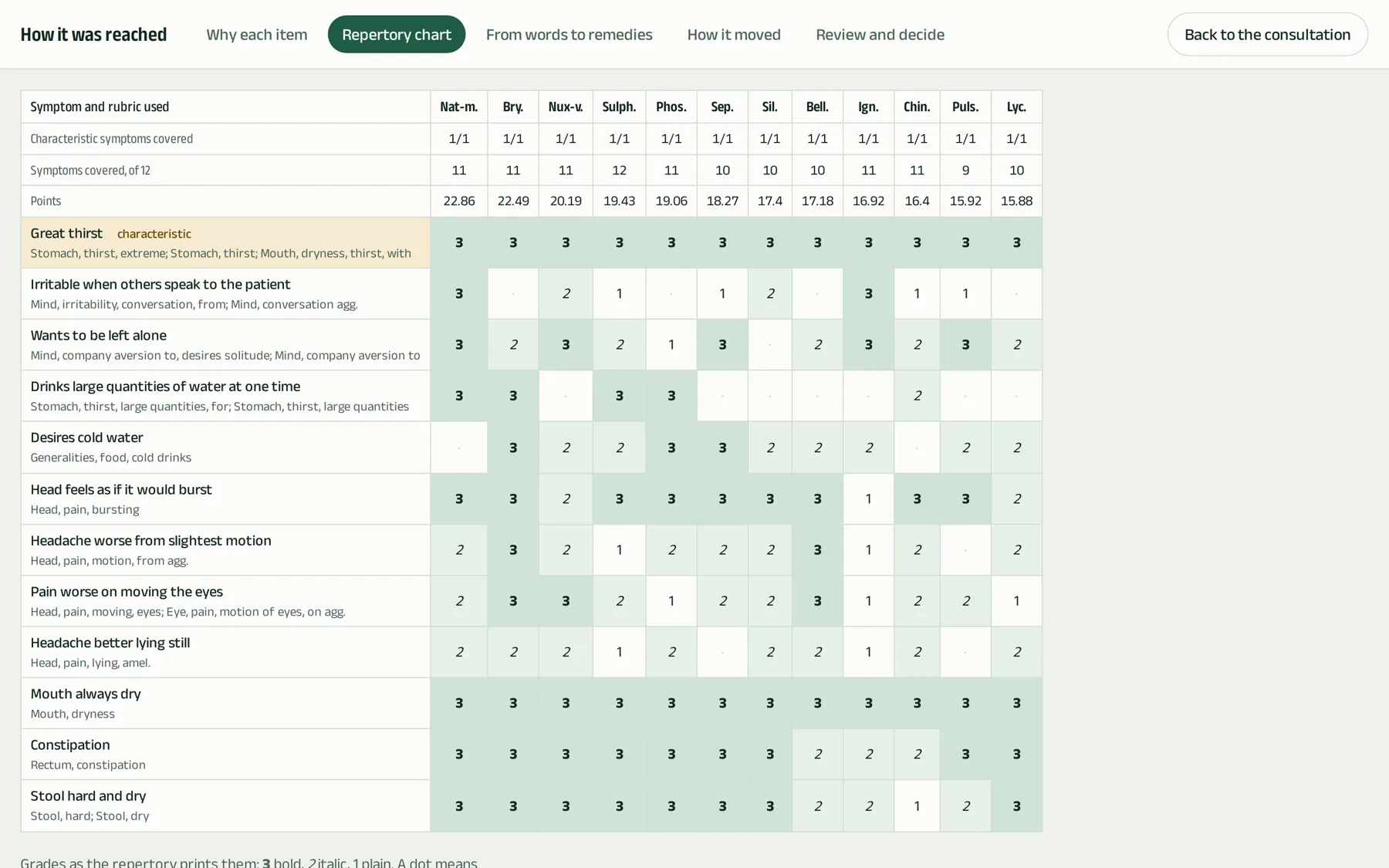
Symptoms down the side, candidates across the top, grades printed the way a repertory prints them: bold, italic, plain. Every point traces back to a rubric and to the sentence the patient spoke.
Disagree with a symptom or a rubric? Challenge it. It is re-analysed on what was said, what the repertory holds, what Boericke says, and the method, kept apart so you can see which is which.
Built on the method, not around it.
Every rule in Totality was argued against the classical texts before it was built. These are the ones that shape what you see.
The characteristic symptoms are yours to name
No remedy is shown until you mark a symptom characteristic. Totality may point to what the record supports, with reasons for and against; it marks nothing for you. Organon §153
A led answer is not yet a symptom
A bare yes to a question that suggested the answer is held back until you ask again openly and confirm it. Organon §87
The whole case, stated honestly
Case notes show what the record holds on modalities, cause, mind, heat and cold, thirst, sleep and the rest, with the patient's words, and say plainly what was never explored. Organon §§83–104
One mark is a lead, not a confirmation
Beside the candidates Totality states how many of your marked symptoms the result rests on. No count is ever called proof.
The repertory finds; the materia medica confirms
Before you decide, your characteristic symptoms are set against Boericke's text for the leading candidates: what fits, what contradicts, what is missing.
Arithmetic you can check by hand
Grade, times the kind of symptom, times a factor that makes broad rubrics count less. Each rubric counts once. The formula is printed on the report.
What Totality will not do.
- It will not prescribe.Candidates are a search aid, always labelled provisional. Remedy, potency and dose are the doctor's.
- It will not guess what is characteristic and rank on its guess.That judgement decides the case, so it stays with the person in the room.
- It will not promise results.Totality makes no claim about the effect of any remedy or about cure.
- It will not hide a gap.Lines it could not read, symptoms without a rubric and parts of the case never asked are shown beside the result.
- It will not replace urgent care.Signs that may need conventional emergency care raise a plain "consider urgent referral" notice.
- It will not keep the audio.The conversation is transcribed and the recording is not stored.
Questions doctors ask.
What is Totality?
Totality is a case-taking assistant for registered homeopathic doctors. It listens to the consultation, writes it down, records the symptoms in repertory terms, and shows how every candidate remedy was reached. The doctor makes each judgement and the final decision.
Does Totality choose the remedy?
No. Totality shows no remedy until the doctor herself marks at least one symptom as characteristic. The candidates it then lists are a search aid from the repertory, always labelled provisional. The doctor confirms against the materia medica and decides.
Which languages does it understand?
Consultations in Malayalam, English, or a mix of both. Suggested questions are shown in Malayalam and English.
Which repertory and materia medica does it use?
Repertorium Publicum, a public Kent-based repertory of 74,482 rubrics with grades 1 to 3, and Boericke's Pocket Manual of Homoeopathic Materia Medica (1906), both from the open OOREP project. Copyrighted repertories such as Synthesis and Complete are not included.
How does it decide which symptoms are characteristic?
It does not. Which symptoms are characteristic of the patient is the doctor's judgement, marked by her. At the review Totality can point out symptoms the record gives strong evidence for, with the reasons for and against, and she accepts or disregards each one.
How are remedy candidates scored?
By plain arithmetic the doctor can check by hand: the rubric grade, times a weight for the kind of symptom (mind 1.5, general 1.25, local 1), times a factor that makes broad rubrics count less. Each rubric counts once. Candidates are ordered first by how many of the doctor's characteristic symptoms they cover.
Is patient information kept private?
Each doctor sees only her own consultations. Audio is not stored. The transcript and the case record are stored so the doctor can reopen them. To transcribe and read the conversation, audio and text are processed by a speech service and an AI service; the patient's consent to this is asked before each consultation starts. See the privacy page.
Who can use Totality?
Registered homeopathic doctors, by invitation. Each account is checked against the doctor's council registration number before it is opened.
Does Totality claim that homeopathic remedies work?
No. Totality makes no claim about the effect of any remedy or about cure. It helps a qualified doctor apply her own method more completely and see the reasoning behind each step. It is not a medical device and does not diagnose.
What device does a doctor need?
A laptop, tablet or phone with a current browser and a microphone. Nothing is installed.
Open to a few doctors at a time.
Totality is in early use with practising homeopaths in Kerala. We open accounts by invitation and check each council registration by hand, so that every doctor on it gets our attention.